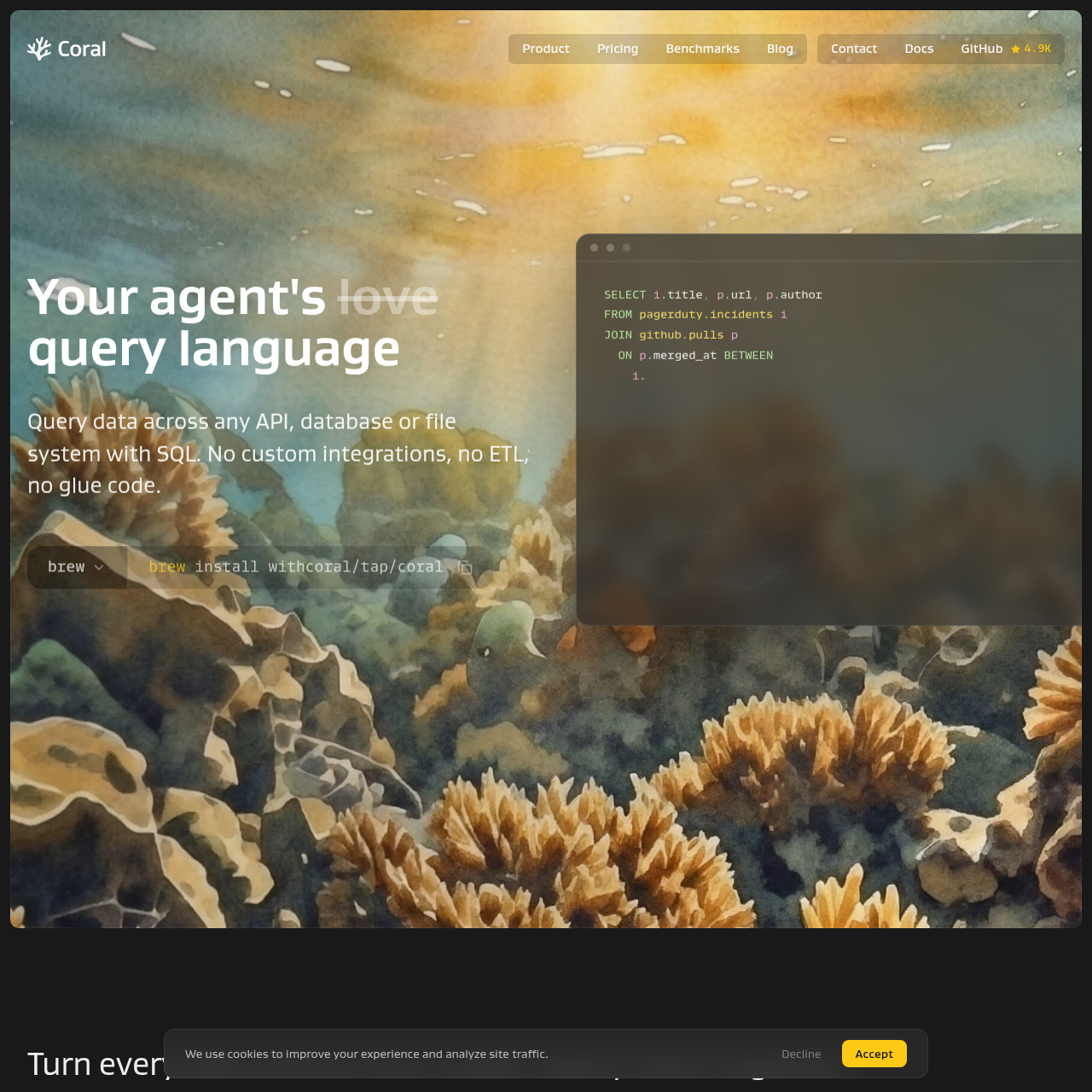
Coral's overview
Coral is a SQL query layer for agents. It turns any API, database, or file system into a read-only schema, so agents can join across sources in a single query — no custom integrations, no ETL, no glue code. Coral handles authentication, pagination, rate limits, and schema mapping, and exposes column-level access controls so you choose what an agent can see. Everything runs locally on your infrastructure; Coral doesn't ingest your data, store results, or train models on anything it sees. Query performance is enhanced through pushdown, caching, and efficient pagination, minimizing API calls and token usage. In benchmarks, agents using Coral are 31% more accurate and 70% cheaper to run than agents using source-level MCPs. Coral adapts to query patterns, improving discovery and execution efficiency over time. It integrates with your existing tools as a standalone data layer. It is open source under Apache 2.0, available via CLI or MCP.
Coral's Key Features
🚀 🔥 Query data across any API, database, or file system with SQL
⭐️ ⚡ Turn every data source into a table and query them together
💎 ✨ Plug it into any agent or framework with one runtime shared across agents
💫 ✨ Turn usage into semantic context with Coral learning relationships and schema hints from every query
Coral's Use cases
🔍 Incident Management Streamline incident response by correlating data from monitoring tools, issue trackers, and communication platforms in real-time.
💼 Customer Support Optimization Prioritize support tickets by joining customer data, ticket statuses, and sentiment analysis to focus on high-value, urgent cases first.
🛠️ Developer Productivity Unblock developers by combining pull requests, CI failures, and linked issues in a single query, accelerating the resolution of broken changes.
Coral's FAQ
What is Coral and how does it help with querying data?
Coral is a query language that allows you to query data across any API, database, or file system using SQL. It eliminates the need for custom integrations, ETL processes, or glue code. Coral connects to your data sources, turns them into readable schemas, and enables you to run SQL queries across them, handling authentication, pagination, rate limits, and schema mapping automatically.
Does Coral store my data, and if so, how is it handled?
Coral does not store your actual data. It stores a small amount of contextual metadata locally and queries your APIs on demand. Hot paths are cached locally with a time-to-live (TTL) to improve performance. Your data remains in your existing SaaS APIs, databases, and object stores, ensuring that it stays within your environment.
How does Coral integrate with existing agent frameworks and tools?
Coral is designed to work with any agent framework. It provides a single SQL connection that agents can use to access governed data across your systems. Coral can be used alongside MCP (Multi-Cloud Provider) or as a standalone data layer. It adds governance, cross-source joins, and caching on top of your existing data sources, making it versatile and compatible with various tools and workflows.
What are the benefits of using Coral for production agent workloads?
Coral offers several benefits for production agent workloads, including read-only access by design, which ensures that agents can query data without mutating upstream systems. It provides scoped tokens, workspace isolation, and per-source permissions for secure access. Additionally, Coral optimizes queries through pushdown, caching, and efficient pagination, reducing unnecessary API calls and token-heavy tool loops. It also adapts to real query patterns, improving discovery, caching, and execution over time.
What are some of the key features and tools that Coral supports?
Coral supports a wide range of tools and data sources, including GitHub, GitLab, Datadog, Sentry, OpenTelemetry, Slack, Intercom, Linear, ClickUp, Incident.io, LaunchDarkly, and Stripe. It allows you to combine data from these sources to gain insights and context that can change outcomes in various domains such as coding, SRE, security, customer escalations, and internal operations. Coral's ability to join data across these sources enables more comprehensive and actionable queries.